
April 13, 2026

Key takeaways
- Match PEEK grade experience (unfilled, GF30/CF30, bearing grades) to your drawing and use case.
- Require a stress/heat control plan (rough → stabilize/anneal → finish) to protect flatness and position.
- Use ISO 9001 as a system check: document control, traceability, calibration, and corrective action.
- Treat 20°C stabilization as part of the inspection method, not a “nice to have.”
- Validate with a pilot run and score suppliers the same way across engineering, quality, and cost.
Table of Contents
- Introduction
- Machining capabilities (what to verify with your PEEK plastic CNC machined components supplier)
- Quality and compliance
- Metrology and inspection
- Commercials and scalability
- Pilot runs and red flags
- Conclusion
- FAQ
Introduction
Choosing the wrong supplier for high-spec PEEK parts is expensive in ways that don’t show up on the first quote. You can lose weeks to warped geometry after rough machining, chase inspection disagreements caused by temperature drift, or discover too late that a supplier can’t control tool wear on abrasive GF30/CF30 grades.
This guide gives you a repeatable, engineering-friendly process to evaluate a PEEK plastic CNC machined components supplier across five areas: machining capability, quality/compliance, metrology, commercials, and validation.
By the end, you’ll be able to shortlist suppliers with the controls and documentation needed to reliably machine unfilled PEEK, glass-filled PEEK (GF30), carbon-filled PEEK (CF30), and bearing grades.
If you’re tracking sourcing work internally, you can tag this process as PEEK machining supplier selection so the evaluation criteria and evidence requirements are consistent across teams.
Key Takeaway: For PEEK, “can you machine it?” is the easy question. The decision hinges on stress control, temperature control, and proof (certs + traceable inspection data).
Machining capabilities (what to verify with your PEEK plastic CNC machined components supplier)
A PEEK plastic CNC machined components supplier should be able to explain why their process stays stable, not just that they have a CNC mill.
This section is where most of the risk lives, because PEEK is sensitive to heat and stress during cutting.
Grade and material expertise
Start by confirming the supplier’s hands-on experience with the exact PEEK grade, not just “PEEK” in a materials list. The machining behavior changes materially with fillers and bearing compounds.
What to ask for:
- The supplier’s typical PEEK grade list (unfilled, GF30, CF30, bearing grades), which they machine routinely.
- Confirmation that they have documented experience with CNC machining PEEK GF30 CF30 (tooling choice, wear monitoring, and inspection plan).
- A short note on how they adjust tooling and parameters for abrasive grades (GF30/CF30).
- A sample material certification package can be provided per batch/lot.
Why it matters: filler-loaded PEEK is more abrasive, so tool wear can move your dimensions even when the first articles look fine. Several machining references recommend diamond/PCD-style tooling approaches for filled grades to manage wear and cutting forces (see practical guidance such as Criterion Precision’s PEEK machining guide).
Process controls and annealing
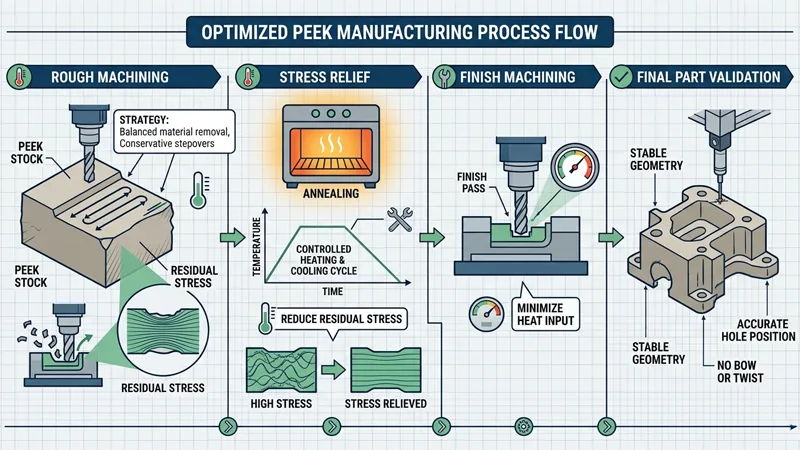
PEEK is sensitive to residual stress. If a supplier relies on a single “finish-only” pass without a stress-relief plan, you’ll see it later as bow, twist, or hole position drift.
A capability-ready supplier should be able to explain (and document) a control sequence such as:
- Rough machining strategy (balanced material removal, conservative stepovers)
- Stress relief (pre-anneal and/or intermediate anneal after roughing)
- Finish machining with controlled heat input
You do not need the supplier to share proprietary recipes, but you do need them to show they understand why stress relief exists and when it’s triggered (tight tolerances, thin walls, asymmetric geometry, large planar faces).
For practical context, multiple machining references emphasize pre-anneal or rough-then-anneal-then-finish cycles for dimensional stability on precision PEEK components (for example, see the process discussion in Advanced EMC’s guidelines for machining PEEK and other advanced polymers).
Fixturing and distortion control
Ask how the supplier fixes PEEK so it doesn’t “relax” after unclamping. This is where many otherwise-capable CNC shops struggle with polymers.
Look for specifics:
- Soft jaws, vacuum fixtures, or sacrificial nests designed for low clamp stress
- Symmetric machining plans (alternate sides; avoid one-sided hogging)
- In-process inspection gates after roughing on high-risk geometry
- Defined “rest” or stabilization time before finishing when needed
A good answer sounds like a control plan, not a reassurance.
Quality and compliance
Certifications and standards
For supplier selection, ISO 9001:2015 is most useful when it shows up as disciplined execution, not a certificate on a wall. ISO 9001 is a quality management system (QMS) standard focused on consistent processes, documented information, and continual improvement (see ASQ’s ISO 9001 overview). This is why many teams treat ISO 9001 as a baseline signal when shortlisting an ISO 9001 CNC machining supplier.
In practical terms, an ISO 9001-certified supplier should be able to show controlled workflows for:
- drawing and revision control
- training and work instructions
- calibration status and measurement traceability
- nonconformance handling (containment + corrective action)
- Supplier management for raw material traceability
What to request from an ISO 9001-certified CNC supplier:
- Scope of certification and the issuing registrar
- Document control method (how revisions are controlled and distributed)
- Calibration program summary (what gets calibrated, frequency, traceability)
- Nonconformance + corrective action flow (how issues are contained and prevented)
If you’re sourcing PEEK for regulated or safety-critical use, treat ISO 9001 as the baseline and align additional requirements in your RFQ (examples: special process controls, cleanliness, change control, packaging).
PPAP and AS9102 readiness
Even if you don’t run a full automotive PPAP or aerospace AS9102 First Article Inspection (FAI) on plastics, readiness is a strong signal that the supplier can produce audit-grade documentation.
Ask whether they can provide, when required:
- Ballooned drawings and characteristic accountability
- First-article dimensional reports with revision and serial/lot traceability
- Process documentation (routing, inspection plan, reaction plan)
You’re not buying paperwork. You’re buying the ability to prove compliance without improvising when your customer or internal quality team audits the build.
Material certification and traceability
Material risk is real with PEEK because grade substitutions and “close enough” equivalents can pass visual checks but fail performance.
Minimum expectations:
- Material certification for each lot/batch (supplier chain documented)
- Traceability from finished part to raw stock and heat/lot
- Defined receiving inspection for polymer stock (visual, dimensional, and documentation checks)
When a supplier cannot explain how they maintain traceability through machining, rework, and split lots, that is a selection risk.
Metrology and inspection
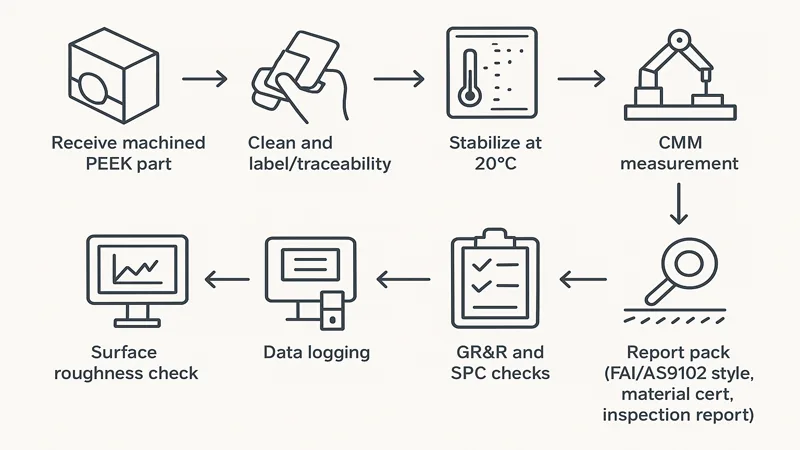
20°C stabilization SOP
Metrology for plastics starts with temperature control. PEEK expands and contracts with temperature, and it can continue to relax after machining if residual stress remains.
Best practice is to require an SOP that covers:
- A controlled inspection environment referenced to 20°C
- A minimum stabilization time before final measurement (especially for tight tolerance work)
- Clear rules for when re-stabilization is required (after washing, after deburring, after long transport)
Some machining/inspection guidance explicitly calls out 20°C ±2°C control and stabilization time before final inspection for PEEK parts (see Criterion Precision’s PEEK machining guide). Treat this as part of PEEK inspection and metrology 20°C requirements: it should be in the SOP and in the inspection report header (environment conditions), not left to tribal knowledge.
CMM and non-contact methods
A capable supplier should match the method to the feature.
Typical best-practice pairing:
- CMM (Coordinate Measuring Machine) for critical datums, true position, flatness/parallelism, and GD&T features
- Optical/non-contact methods for delicate edges, thin walls, or surfaces where probe force could deflect the part
- Surface roughness measurement when Ra is function-critical (seals, bearings)
Ask for the actual equipment list and calibration status—not just “we inspect everything.”
GR&R and SPC evidence
If your tolerance stack is tight, measurement variation and tool wear variation matter.
Request evidence such as:
- GR&R (Gage Repeatability and Reproducibility) results for the measurement method used on your critical features
- SPC (Statistical Process Control) charts or capability evidence for repeat dimensions, especially on filled PEEK, where tool wear can shift size
You’re looking for proof that the supplier can detect drift early and react before you get a bad lot.
Commercials and scalability
Transparent RFQ and itemization
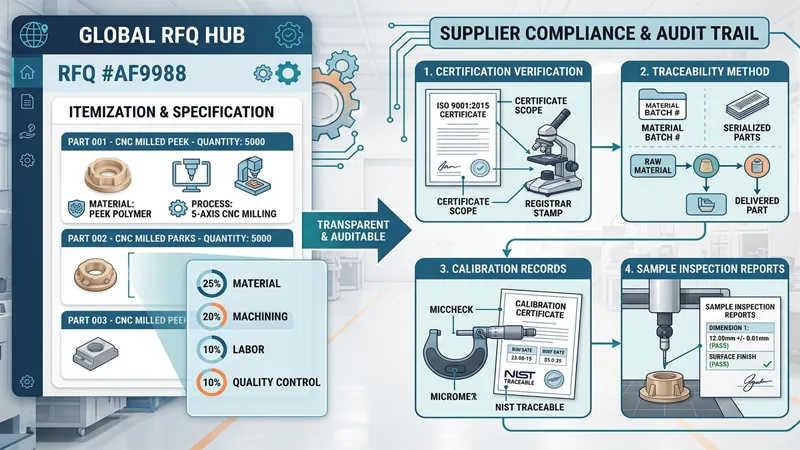
AFI Industrial Co., Ltd. (AFI Parts) notes on its website that it supports CNC milling and lists PEEK among machinable plastics, and it also states it is ISO 9001:2015 certified. If you’re evaluating AFI Parts (or any similar supplier), treat these pages as a starting point for your RFQ checklist—then request the same auditable artifacts you would require from every bidder: certificate scope, traceability method, calibration records, and sample inspection reports.
Relevant reference pages:
- CNC milling
- CNC machining materials (includes PEEK)
- How a CNC machined parts manufacturer ensures quality
- Precision machining & fabrication FAQ
A good PEEK supplier quote is not a single number. It is a breakdown that helps you manage risk and plan scale.
Ask for itemization at a minimum:
- Material (grade and form: rod/plate), yield assumptions, and scrap factors
- Programming/setup time and number of setups
- Tooling assumptions (especially for GF30/CF30 abrasion)
- Inspection effort (CMM time, report type, sampling plan)
- Secondary ops (deburr, cleaning, marking, packaging)
This is also where you can compare suppliers neutrally on response quality. In your documentation and search tracking, label this stage as PEEK machining supplier selection so engineering and procurement are aligned on what evidence is required.
Lead time, MOQs, and capacity
For PEEK, lead time is often driven by:
- Raw material availability for your specific grade and form
- Tooling and tool life planning (filled grades)
- Inspection/reporting scope
- Queue time and capacity commitments
Ask suppliers to separate:
- Prototype lead time (first build)
- Repeat lead time (steady state)
- Expedited options and what changes (cost, inspection scope, overtime)
MOQs are usually negotiable when a supplier has repeatable setups and a clear scale plan. What matters more than MOQ is the supplier’s ability to hold process consistency as volume ramps.
Total cost and cost-down roadmap
PEEK parts often offer cost-down opportunities that don’t compromise performance.
A credible supplier should be willing to propose a roadmap, such as:
- Tolerance review: tighten only what is function-critical
- Datum strategy and fixturing changes to reduce setups
- Geometry edits that reduce distortion risk (and rework)
- Inspection optimization after capability is proven (sampling plans, automated reporting)
If a supplier can’t explain cost drivers, you won’t get predictable cost-down later.
Pilot runs and red flags
Verification during NPI/PPAP

Treat the first run as a validation exercise, even if the quantity is small.
Minimum pilot expectations:
- A documented control plan for the first build
- First-article inspection report (FAI-style) aligned to your drawing
- Material cert package and traceability identifiers on labels/packaging
- A clear deviation/waiver process if something doesn’t meet spec
If your program requires it, align the pilot deliverables to PPAP elements (ballooned print, dimensional report, material certs, process flow), so you’re not rebuilding the documentation later.
Red flags to avoid
These are common selection failure modes for high-spec PEEK:
- “We machine PEEK all the time,” but no explanation of grade differences (GF/CF/bearing)
- No stress-relief strategy for thin walls, large flats, or asymmetric geometry
- Vague inspection statements with no temperature stabilization plan
- No traceability beyond a packing slip
- Quotes that are not itemized (hidden inspection/tooling costs show up later)
- Tool-wear drift not monitored (no SPC / no defined tool-change triggers)
Supplier scorecard matrix
Use a simple matrix so engineering and procurement can score suppliers the same way.
Suggested scoring (1 = weak, 5 = strong):
| Category | What “5” looks like | Score (1–5) |
|---|---|---|
| Grade expertise | Demonstrated GF30/CF30/bearing-grade experience + parameter/tooling rationale | |
| Process control | Rough/anneal/finish plan + documented triggers + controlled heat/chip evacuation | |
| Fixturing & distortion | Purpose-built fixturing approach + in-process checks | |
| ISO 9001 execution | Certificate scope + evidence of document control, calibration, CAPA | |
| Traceability | Lot-to-part traceability + material cert package + labeling | |
| Metrology SOP | PEEK inspection and metrology 20°C stabilization SOP + method-fit (CMM/optical) + calibrated equipment | |
| GR&R / SPC | Evidence for critical features + reaction plan for drift | |
| Quote transparency | Itemized RFQ response + assumptions stated | |
| Lead time & capacity | Clear prototype vs repeat lead times + ramp plan | |
| Cost-down roadmap | Tolerance/DFM suggestions + setup reduction plan |
A supplier doesn’t need perfect scores everywhere, but you should know exactly which risks you are accepting.
Conclusion
A strong PEEK plastic CNC machined components supplier is defined by alignment: grade expertise, stress and heat controls, ISO 9001-backed quality systems, metrology discipline (including 20°C stabilization), and a clear total-cost story.
Next steps:
- Issue an RFQ that forces itemization (material grade, setups, tooling, inspection/report type, packaging).
- Run a pilot build with an FAI-style report, full material certification, and traceability.
- Score suppliers with a matrix, then dual-source the highest-risk parts.
If you want, I can turn the scorecard and RFQ itemization points above into a one-page RFQ checklist you can reuse across suppliers.
FAQ
How do suppliers control distortion and stress when CNC machining PEEK?
What are the challenges of machining glass-filled (GF30) or carbon-filled (CF30) PEEK?
Why is 20°C stabilization critical for inspecting PEEK machined parts?
Why is ISO 9001 certification important when choosing a PEEK machining supplier?
What information should be itemized in an RFQ for PEEK CNC machined components?